
Air receiver position: dry or wet?
The general industrial best practice is the two-receiver setup: a wet receiver before the dryer (dampens the compressor cycles and promotes water condensation) and a dry receiver after (stores dry air and stabilizes network pressure). The receiver is not just a volume: it is a tool for energy and pneumatic stabilization.
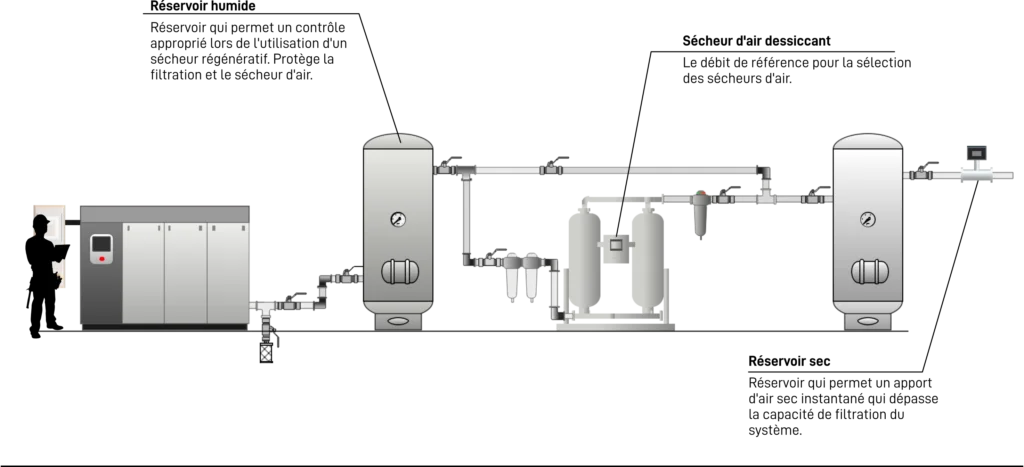
Configurations of systems made up of refrigerated dryers and heatless (no heated purge) desiccant dryers.
Summary table: recommended configurations
| Configuration | Main purpose | Dryer type | Typical use case |
|---|---|---|---|
| Dry and wet receiver | Stabilize flow and pressure, maximize water separation | Refrigerated / heatless | Plant with variable load and an extended network |
| Wet receiver only | Dryer protection, simple regulation | Refrigerated / heatless | Simple installations, relatively stable load |
| Dry receiver only | Protection of the desiccant dryer and the after-filter | CANNOT be configured with a desiccant dryer | Critical air, instrumentation, sensitive processes |
General principles to remember
- The receiver is not just a volume: it is a tool for energy and pneumatic stabilization
- The dryer does not like rapid flow variations
- Free-water separation must happen as early as possible
- Positioning directly affects: dryer performance, energy consumption, network reliability and delivered air quality
Configuration 1: dry and wet receiver
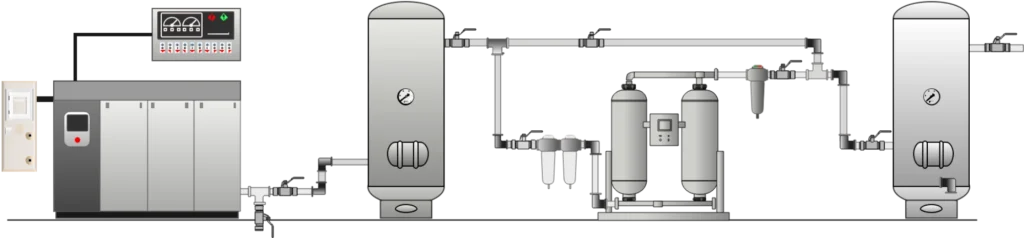
Technical rationale
This configuration is considered the general industrial best practice.
- The first receiver (wet): dampens the compressor’s load/unload cycles, reduces instantaneous flow peaks and promotes the natural condensation of water
- The dryer receives: a more stable flow and air already partly free of free water
- The second receiver (dry): stores dry air, stabilizes network pressure and reduces abrupt flow demands on the dryer
CAGI recommends portioning control storage roughly 1/3 wet / 2/3 dry: this captures the advantages of both, radiant cooling and water (and oil) capture on the wet side, an immediately available reserve of dry air on the dry side, while limiting the risk of overloading the dryer during a large flow event.
This configuration maximizes dryer efficiency and reduces energy losses.
Application example
- Manufacturing plant with several intermittent pneumatic stations and significant demand variations
- Refrigerated dryer sized close to the compressor capacity
- Goal: stability, longevity, overall system performance
Configuration 2: wet receiver only
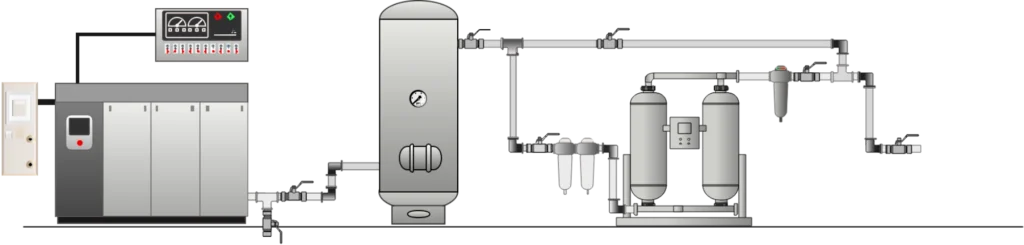
Technical rationale
This configuration is a simplified version, often used by default.
- The receiver acts as: a flow buffer and a primary water separator
- The dryer is protected against: flow peaks and too-frequent starts
- No dry receiver: less dry-air storage, network pressure more directly dependent on the dryer
Acceptable when demand is relatively stable.
Application example
- Light manufacturing workshop
- Few load variations, short network
- Refrigerated dryer with an efficient electronic drain
Configuration 3: dry receiver only
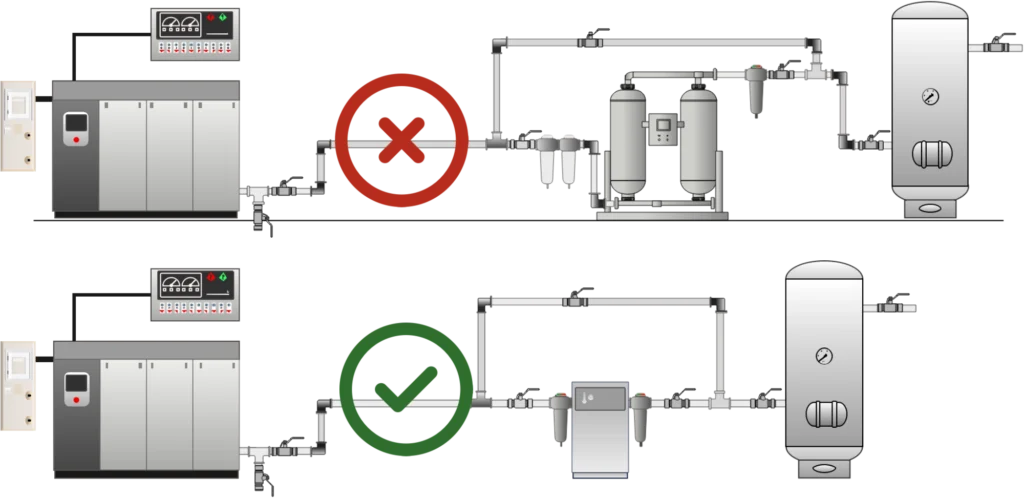
Technical rationale
This configuration is specific and must be used intentionally. ⚠️ It does not suit a desiccant dryer: a desiccant requires a wet receiver upstream and cannot operate with a dry receiver alone (use configuration 1).
- The dryer receives: hot, humid air, with no flow damping, always at 100 % of the compressor flow with no modulation option (load/unload)
- Intended benefit: all the stored air is already dry; no re-contamination with water after drying
- Drawbacks:
- flow variations transmitted directly to the compressor: immediate reaction to pressure variations between the dryer and the compressor; the desiccant dryer acts as a check valve, which prevents reading the air network pressure
- risk of oversizing
- increased stress on the purge cycles (heatless)
To be used when an operation requires a flow exceeding the refrigerated air dryer’s capacity. Use configuration 1 when using a desiccant dryer.
Application example
- Instrument air, moisture-sensitive processes
- Critical networks with a low total volume
- Occasional need for flow beyond the refrigerated dryer’s capacity
Specifics: refrigerated dryer
- Always favor: a receiver upstream and effective water separation before the dryer
- The refrigerated dryer: does not remove residual vapor and is very sensitive to rapid flow variations
The Compressor → Receiver → Dryer configuration is generally optimal.
Specifics: heatless desiccant dryer
- The main energy cost comes from the purge
- Any flow instability: increases purge air consumption and degrades the dew point
- A wet receiver before the dryer is required (stability and purging); a dry receiver may be added downstream for quality. A desiccant never works with a dry receiver alone.
The choice depends on the quality / energy-efficiency trade-off.
Sizing and certifying the receiver
- Volume: CAGI notes that common rules of thumb (1 gal/SCFM, or more realistically ≈ 10 gal/SCFM of the trim compressor’s capacity) are no substitute for a calculation: size the storage so that no compressor starts more than ~10 times per hour. CAGI stresses that total storage is the one variable in an air system that cannot be oversized: “more is always better.”
- Certification: every air receiver must comply with the ASME Code for Unfired Pressure Vessels (safety valve, pressure gauge, reliable drain) and meet applicable codes. In Québec, a pressure vessel falls under the RBQ; see Pressure installations: resources.
Final summary
- There is no universal configuration
- Receiver positioning must be: intentional, based on the required air quality and consistent with the dryer type
- A poor layout can: increase energy consumption, reduce equipment life and create recurring water problems in the network
References
- CAGI: Compressed Air & Gas Handbook (7th ed., 2021), Chapter 4 “Compressed Air System Design”: wet vs dry control storage, 1/3 wet / 2/3 dry split, sizing (≤ ~10 starts/h), “storage cannot be oversized”
- ASME: Code for Unfired Pressure Vessels (air receiver certification)