
Choosing a refrigerated dryer: purchase and rental
The refrigerated dryer offers generally the lowest energy and preventive-maintenance cost among air-dryer types. It suits general industry (dew point ≈ 3 °C), but it should be avoided if the process requires a dew point below 1 °C or if the environment is exposed to freezing, water jets or heavy dust.
Strengths and weaknesses of the refrigerated dryer
| Strengths | Avoid if: |
|---|---|
| Optimal energy efficiency | A dew point below 1 °C (33 °F) is needed, piping exposed to freezing |
| High reliability in a suitable environment (NEMA 1) | Possibility of water jets and heavy dust (NEMA 1) |
| Low maintenance cost | Sensitive to out-of-range ambient parameters (freezing and heat) |
| Ultra-simple operating principle, familiar to all refrigeration technicians | |
| No air flow loss, no regeneration |
Choosing an integrated or external refrigerated dryer?
Integrated dryer
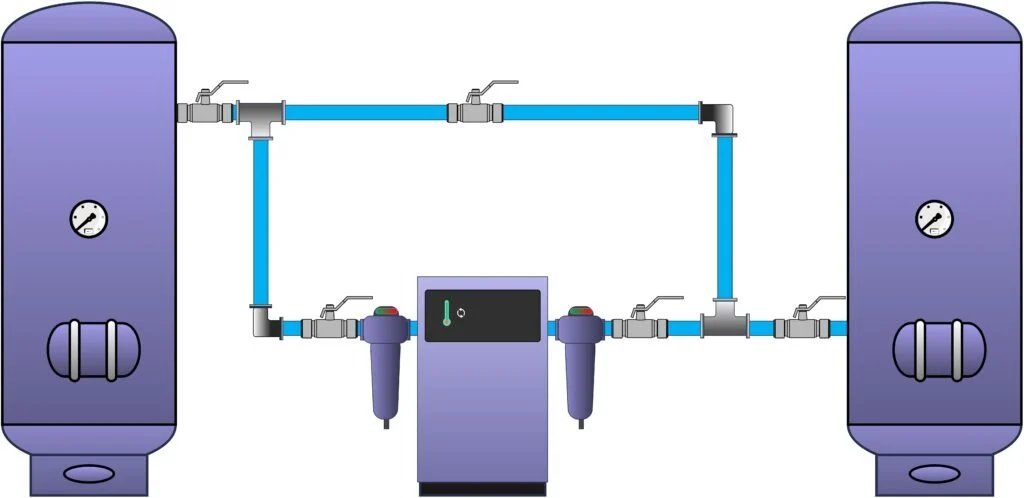
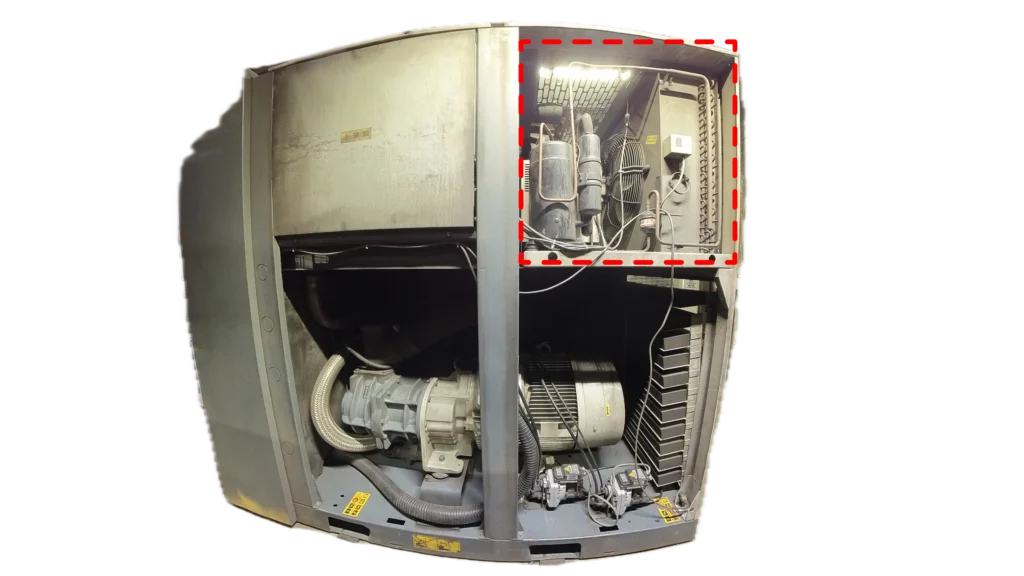
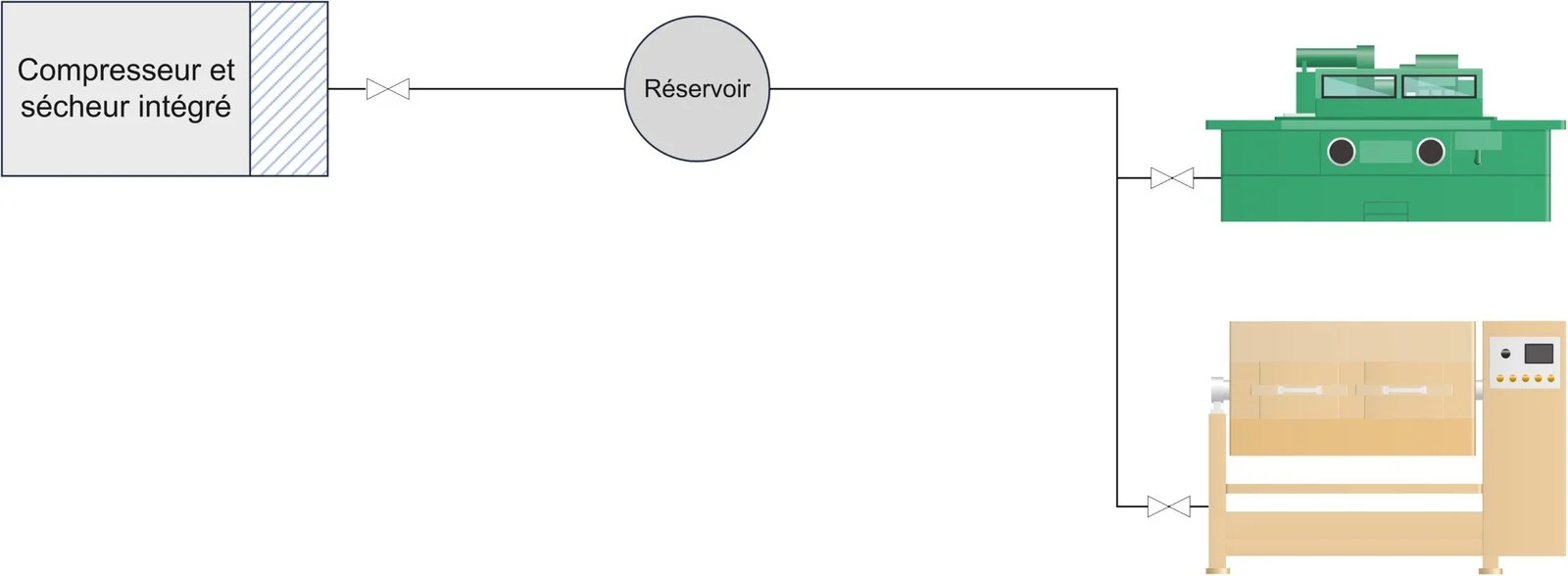
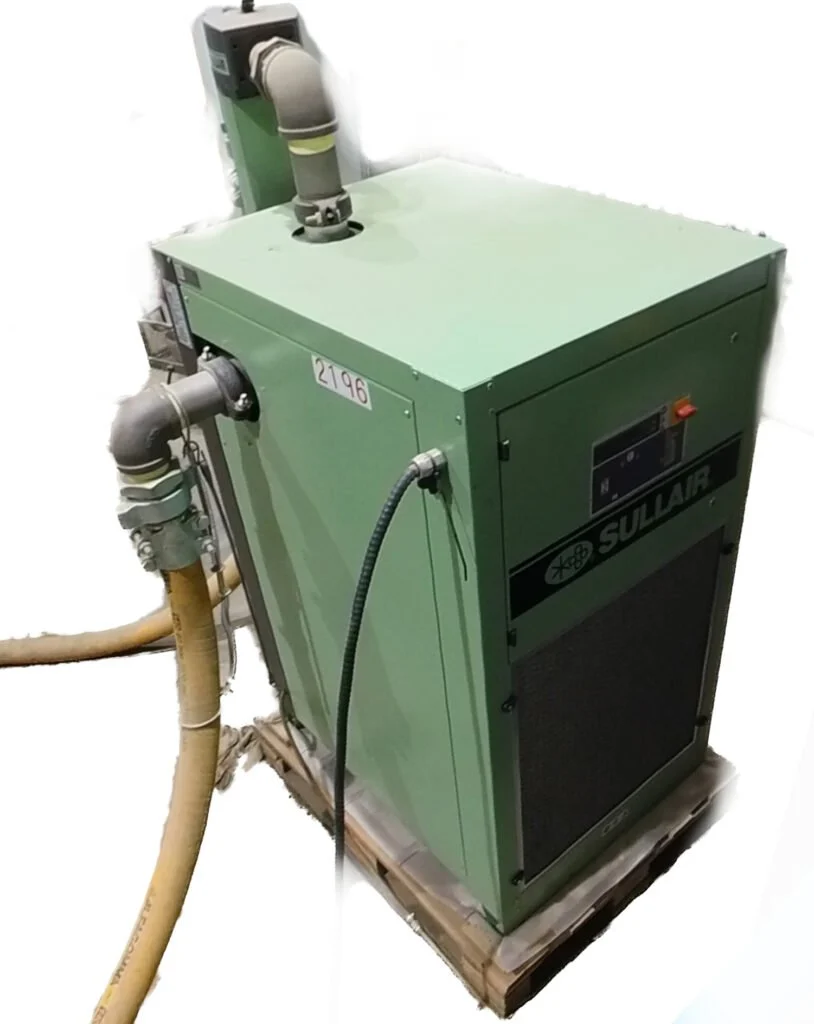
The integrated dryer provides fairly significant space savings. This choice eliminates the cost of connecting to the compressed air network.
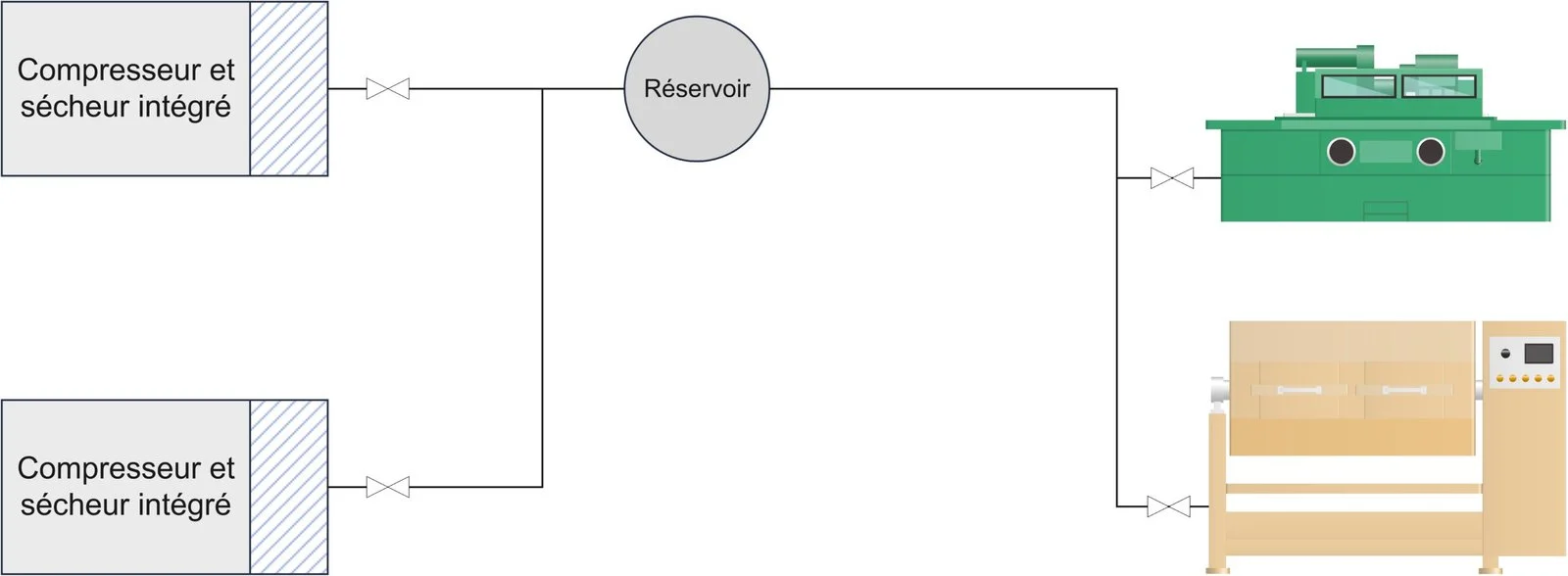
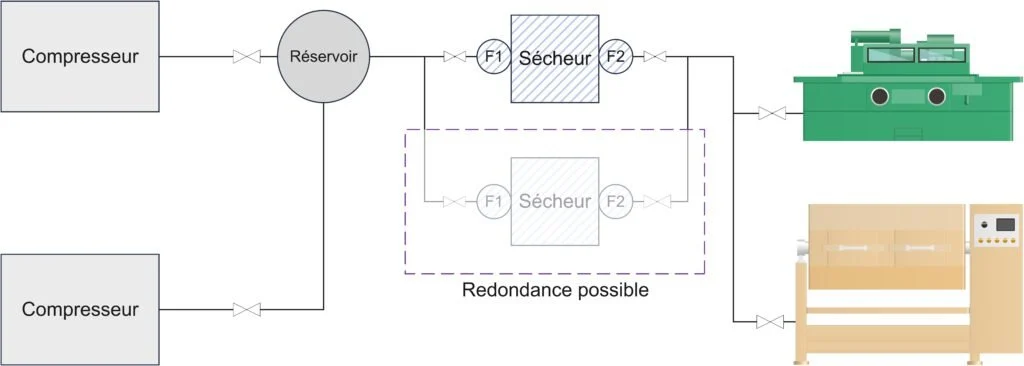
It is important to know that when the dryer breaks down, in order to carry out a safe repair, you must stop the compressor in addition to the dryer. No dryer redundancy is possible.
External dryer
The external dryer is more versatile and allows redundancy. The components are very accessible when repairing the refrigeration circuit.
Parts cost less and most local refrigeration technicians have the skills to carry out repairs and diagnostics, without the manufacturer’s assistance.
Cycling or non-cycling?
Two control modes exist, and they behave differently and cost differently.
- Non-cycling: the refrigeration circuit runs continuously, at full load, regardless of air demand. The dew point stays stable, but the dryer uses the same energy even at low flow. Simple build, lower purchase cost.
- Cycling (thermal mass): the refrigeration compressor shuts off once the air is cold enough, then restarts. At part load, the energy saving is real. In return, the dew point swings slightly upward between cycles, and the unit costs a little more to buy.
How to decide. If the flow is fairly constant and the electricity bill is secondary, non-cycling is enough. If the flow varies a lot (shifts, seasons, intermittent lines), cycling pays for itself through the energy saved. The two columns in the price table below reflect this gap.
Installation planning
To plan for when installing a refrigerated air dryer:
| To do | Description |
|---|---|
| Electrical | Between 120 V and 575 V, depending on the dryer size |
| Provide clearance | Clearance to allow ventilation (depending on model and capacity). Plan for the possibility that the refrigerant compressor may be replaced when positioning the dryer. |
| Ambient temperature | Minimum 4 °C (39 °F) · Maximum 45 °C (113 °F) |
| Plumbing | Respect the dryer’s piping diameter and a velocity of 25 ft/s (7.62 m/s) or less |
| Condensate drain | Connect the drain outlet to the condensate treatment system (oil-water separator) |
| Pre-filter | A pre-filter is required for long-term reliability. Some manufacturers install it inside the dryer (e.g. Mikropor, Airtek). |
| Mandatory approvals in Québec | CSA and CRN/NEC |
| Optional | Provide a dryer bypass circuit |
Please refer to the specifications of your air dryer supplier. The scope above is for pre-project planning.
Unit used to determine a dryer’s capacity: SCFM
The unit is SCFM (CAGI). The dryer performance conditions are as follows:
| Conditions | Values |
|---|---|
| Compressed air inlet temperature (T° in the piping) | 100 °F |
| Compressed air inlet pressure | 100 psig |
| Maximum ambient temperature | 100 °F |
| Compressed air relative humidity (in the piping) | 100 % (saturated) |
CAGI SCFM is: volume of free air in ft³/min at 14.5 psia (1.0 bar), 68 °F (20 °C), 0 % RH.
How to choose the right capacity: sizing and selection
Method / formula
CFtotal = F1 × F2 × F3 × F4
- F1 = correction factor, inlet pressure
- F2 = correction factor, ambient temperature
- F3 = correction factor, compressed air temperature
- F4 = correction factor, final dew point
Dryer capacity = flow consumed by the plant ÷ CFtotal
Always round up to the larger dryer.
Correction factors for refrigerated dryers
Each factor adjusts the rated capacity in SCFM based on a deviation from the ISO test conditions.
F1: inlet pressure
| psig | 60 | 80 | 100 | 120 | 140 | 160 | 180 | 203 |
|---|---|---|---|---|---|---|---|---|
| bar | 4 | 5.5 | 7 | 8 | 10 | 11 | 12 | 14 |
| F1 | 0.78 | 0.90 | 1.00 | 1.10 | 1.15 | 1.20 | 1.25 | 1.30 |
F2: ambient temperature
| °F | ≤80 | 90 | 95 | 100 | 105 | 110 | 115 | 122 |
|---|---|---|---|---|---|---|---|---|
| °C | ≤27 | 32 | 35 | 38 | 40 | 43 | 45 | 50 |
| F2 | 1.11 | 1.09 | 1.05 | 1.00 | 0.95 | 0.85 | 0.75 | 0.65 |
F3: inlet air temperature
| °F | ≤90 | 100 | 110 | 122 | 130 | 140 | 150 | 158 |
|---|---|---|---|---|---|---|---|---|
| °C | ≤32 | 38 | 43 | 50 | 55 | 60 | 65 | 70 |
| F3 | 1.165 | 1.00 | 0.80 | 0.70 | 0.60 | 0.50 | 0.45 | 0.40 |
F4: pressure dew point (PDP)
| °F | 38 | 41 | 45 | 50 |
|---|---|---|---|---|
| °C | 3 | 5 | 7 | 10 |
| F4 | 1.00 | 1.08 | 1.20 | 1.36 |
Note: F4 > 1 means you can tolerate more humidity, so the dryer can handle more flow.
Calculation example
| Field conditions (in the plant / mechanical room) | Values | Factor |
|---|---|---|
| Total plant consumption | 866 SCFM | — |
| F1. Compressed air inlet pressure | 120 psig | 1.10 |
| F2. Ambient temperature | 100 °F | 1.00 |
| F3. Compressed air inlet temperature (T° in the piping) | 122 °F | 0.70 |
| F4. Dew point tolerated by the process | 38 °F | 1.00 |
1. Calculate the correction factor
CFtotal = F1 × F2 × F3 × F4 = 1.10 × 1 × 0.70 × 1 = 0.77
2. Apply the correction factor to the flow to be treated
Dryer capacity = 866 SCFM ÷ 0.77 = 1,124.68 SCFM
Answer: the compressed air dryer must have a capacity of 1,124.68 SCFM or more.
The real dew point: the +6 °C trap
A refrigerated dryer is often sold for class 4 (+3 °C), but that is the dew point obtained at test conditions. In the plant, the real dew point depends on pressure, inlet and ambient temperatures (factors F1 to F4 above) and the state of the dryer. An undersized, fouled unit, or one installed in a too-hot room, drifts upward: the dew point can climb to +7 °C (class 5), even +10 °C (class 6). Cycling control, by letting the dew point swing, works in the same direction.
In other words, “refrigerated” does not guarantee class 4: it is the dew point measured at your conditions that sets the real ISO class. Size with the correction factors, allow a margin, and check the value on the controller. For the dew-point concept and the classes, see Dew point in compressed air.
Budget price of refrigerated dryers: 100 to 5,000 SCFM
Installation not included. Commissioning not included.
| Capacity (SCFM) | Cycling dryer | Non-cycling dryer | Filter (housing + element) | Commissioning |
|---|---|---|---|---|
| 100–200 | $3,000 – $6,000 | $2,500 – $4,500 | $520 – $870 | $575 – $800 |
| 300–500 | $5,000 – $9,000 | $4,000 – $7,000 | $880 – $1,420 | $575 – $800 |
| 750–1,000 | $8,000 – $15,000 | $6,500 – $12,000 | $1,480 – $2,260 | $1,400 – $2,000 |
| 1,500–2,000 | $14,000 – $25,000 | $11,000 – $20,000 | $2,400 – $3,780 | $1,400 – $2,000 |
| 3,000 | $22,000 – $40,000 | $18,000 – $32,000 | $4,450 – $5,400 | $1,400 – $2,000 |
| 5,000 | $35,000 – $65,000 | $30,000 – $55,000 | $6,900 – $8,500 | $2,800 – $3,500 |
Freight extra. Several manufacturers offer “drop-ship”.
Mistakes to avoid
- Installing an air dryer in an unheated space in winter (e.g. sawmill, warehouse, job site)
- Installing a refrigerated dryer outdoors, exposed to the weather (e.g. temporary outdoor rental)
- Calculating the correction factors with the wrong temperature parameters (see the CTD article)
- Connecting the dryer with a piping diameter smaller than the diameter at the dryer
- Buying a dryer with an unpopular or obsolete refrigerant type
- Installing a forced-air ventilation duct directly on the dryer