
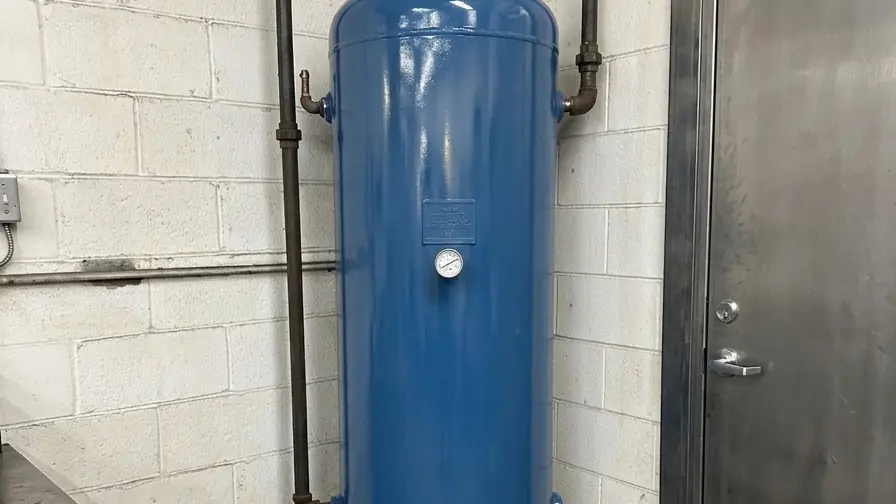
Mandatory compressed air receiver inspection: frequency and requirements
A regulated compressed air receiver under the Regulation respecting pressure installations (B-1.1, r. 6.1) must undergo periodic external inspection, even if it is exempt from an installation permit or welding. The base frequency is set by Table 1 under section 78, but three situations, relocation, a change in use, and a prolonged shutdown, trigger an inspection requirement. This article summarizes how often to inspect, what pushes a receiver off the normal schedule, and who is authorized to carry out the inspection at your plant.
Disclaimer. This article is provided for informational purposes only and does not constitute official legal or technical advice. Any decision related to the inspection, maintenance, or operation of a compressed air receiver must be validated by a qualified professional and comply with the requirements of the competent authorities. Refer to the regulation in force and to the RBQ for your official legal obligations.
Periodic inspection frequency (section 78)
Section 78 refers to a frequency table that applies to each category of pressure equipment. For a compressed air receiver, the applicable line is:
| Equipment type | External inspection | Internal inspection |
|---|---|---|
| Compressed air receiver | Every 4 years | Not required |
The table also covers other equipment categories (boilers, autoclaves, steam generators, etc.) at different frequencies, only the line applicable to compressed air receivers is reproduced here. A receiver holding a non-corrosive fluid follows the exact same frequency (4 years, external only).
Staying compliant, step by step
- Confirm whether your receiver is regulated : check using the RBQ flowchart and the complete guide on CRN and permits.
- Track the 4-year deadline : starting from commissioning or the last external inspection.
- Watch for the 3 out-of-cycle triggers : relocation (section 79), a change in operating conditions, or a shutdown of more than one year (section 81).
- Hire a recognized person : an inspector or body recognized by the RBQ; see the RBQ resources list.
- Keep the inspection report : your proof of compliance if it’s ever requested.
Who can inspect a receiver?
Only a recognized person may inspect pressure equipment (section 71). A recognized person is someone who holds the qualifications to inspect pressure equipment (over 15 PSIG) and who is recognized by the RBQ. To hire a recognized person : an inspector or a body recognized by the RBQ, see the RBQ resources list.
Onyx M3 recommends contacting your insurer first. Some insurers hold the permits and certifications needed to carry out your periodic inspections at a lower cost.
Concrete example
A compressed air receiver commissioned in June 2022, with no prolonged shutdown or change in use:
- Next external inspection due: June 2026, 4 years after commissioning (normal cycle under section 78).
- If it is relocated to another building in 2025, section 79 requires both an internal and external inspection before it is put back into service at the new location, the 4-year clock then restarts from that inspection.
- If the plant shuts down for more than 12 months and the receiver sits idle, section 81 requires an inspection and RBQ authorization before any restart, even if the 4 years have not elapsed. The prescribed period is 1 year.
Why it’s worth tracking ahead of the deadline. A receiver that is overdue for inspection can be taken out of service by an inspector, delay production, or complicate an insurance claim after an incident. During an assessment or compressed air audit conducted by Onyx M3, we review the general condition of your installations and flag receivers approaching their inspection deadline. The recognized person remains the only one authorized to carry out the regulatory inspection itself.
See also
- Complete guide, compressed air receivers in Québec (RBQ / CRN) : applicability, CRN, installation permits, mandatory components.
- Order in Council 1056-2026: RBQ permit for a compressed-air receiver : non-welded connection, section 16, paragraph 4, thresholds in force since 30 July 2026.
- RBQ, pressure installations: resources : list of recognized persons, declaration form, permit holders.
- Air receiver: before or after the dryer? : receiver positioning and ASME/RBQ certification.
References
-
RBQ, Regulation respecting pressure installations (B-1.1, r. 6.1), sections 78 to 81 and Table 1, view the regulation.
-
Onyx M3, A complete guide to compressed air receivers in Québec : applicability, CRN and installation permits.