
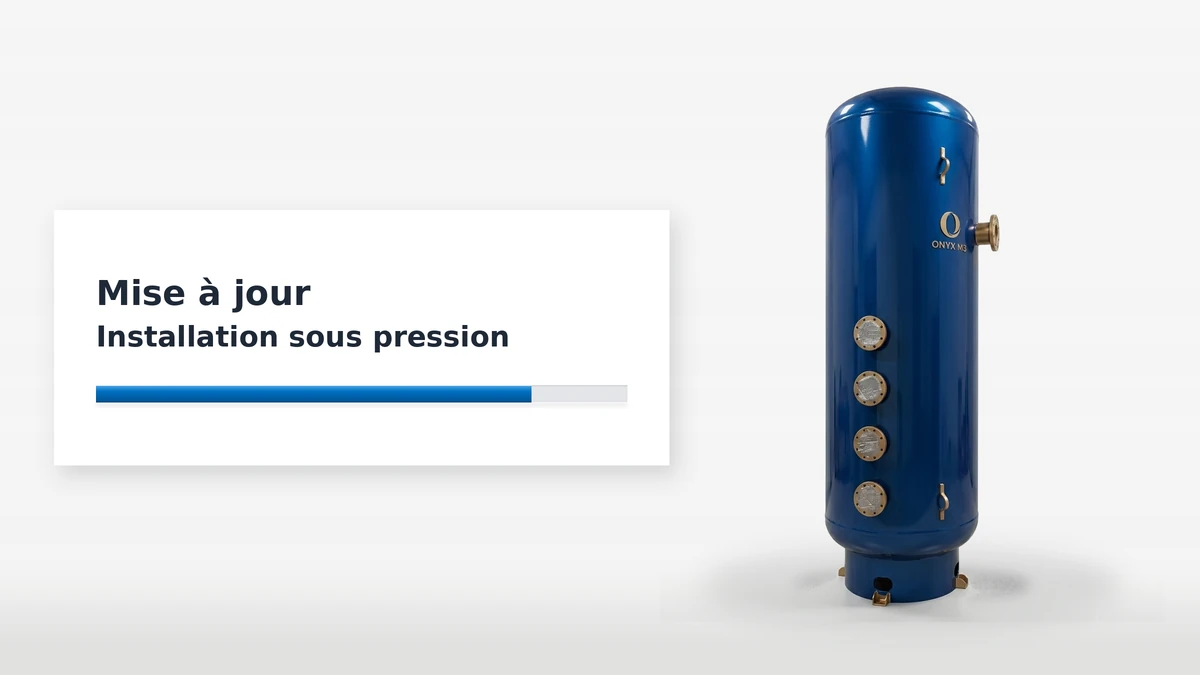
Order in Council 1056-2026: RBQ permit for a compressed-air receiver
Sources Gazette, 15 July 2026 RISP, LégisQuébec RBQ, laws and regulations
Note. Informational text only. Validate any decision with a qualified professional and the Order as published in the Gazette. The authority for pressure installations in Québec is the RBQ.
Before 30 July 2026, and since
Takeaway. Since 30 July 2026, a non-welded connection under all four thresholds no longer needs an installation permit. The CRN and installation declarations remain required where applicable.
| Topic | Before 30 July 2026 | Since 30 July 2026 |
|---|---|---|
| Installation permit, non-welded connection | Required (s. 14), except exemptions already in s. 16, paras. 1 to 3 | Waived if all four conditions of s. 16, para. 4 are met |
| CRN, declarations, periodic inspection | Required where applicable | Unchanged: paragraph 4 does not lift them |
Who is exempt
For that specific work, no longer, since 30 July 2026, if all four conditions of section 16, paragraph 4 are met. Otherwise section 14 still requires an installation permit.
The Order, section 21, adds this paragraph to RISP section 16. Official French text (opposable):
Verbatim excerpt. « 4° les travaux de raccordement sans soudage d’un réservoir à air dont la pression maximale de marche permise n’excède pas 1 725 kPa, dont le volume n’excède pas 651 litres et dont le diamètre n’excède pas 0,61 m; »
Unofficial working translation: 4° non-welded connection work on an air receiver whose maximum allowable working pressure does not exceed 1 725 kPa, whose volume does not exceed 651 litres and whose diameter does not exceed 0.61 m;
All four conditions are cumulative. Miss one and the exemption does not apply.
| Condition | Threshold |
|---|---|
| Work | Non-welded connection |
| PMMP | ≤ 1 725 kPa (~250 psi) |
| Volume | ≤ 651 L (~172 US gal) |
| Diameter | ≤ 0.61 m (~24 in) |
What the exemption is not
Section 16, paragraph 4 addresses only the installation permit for non-welded connection work under the thresholds.
Paragraph 4 covers: the installation-permit waiver for that work, if all four conditions are met.
Paragraph 4 does not lift:
- the CRN (the cited text does not state a CRN change);
- installation declarations, where applicable;
- periodic inspection;
- the welding requirement: welding on the receiver or on the connection drops the exemption;
- the mobile receiver: that exemption comes into force on 30 July 2028.
For CRN, operator-user permits and inspections, the guide to compressed-air receivers in Québec remains the starting point; this article does not replace it.
Date and opposable text
| Marker | Sources |
|---|---|
| Order | 1056-2026, 2 July 2026, amending the RISP |
| Publication | Gazette officielle du Québec, 15 July 2026, 158th year, No. 28, Part 2, p. 4216 onward |
| General coming into force | S. 68 of the Order: 15th day after publication → 30 July 2026 |
| Internal corroboration | S. 67 of the Order refers to the text of s. 10 “as it read on 29 July 2026” (the day before coming into force) |
| RBQ announcement | The RBQ press page of 15 July 2026 states 29 July. One-day discrepancy: this article uses 30 July 2026, from s. 68 |
| Consolidation | RISP, LégisQuébec |
Important. Section 16, paragraph 4 is not among the exceptions in s. 68, paras. 1 to 6. It has therefore been in force since 30 July 2026.
The online consolidation of the RISP may still read “up to date as of 1 April 2026”: section 16 then lists only paragraphs 1, 2 and 3. The opposable text of the new paragraph 4 is the Order published in the Gazette, not yet the consolidated page. Do not treat the missing paragraph 4 on LégisQuébec as proof that it is not in force.
Other changes already in force
Air receiver of 114 L or less (s. 5, para. 3). The Order, section 4, amends section 5, paragraph 3: the provisions on installation, use and maintenance do not apply to an air receiver whose volume does not exceed 114 litres (~30.1 US gal). That is a scope question, distinct from the permit exemption in s. 16, para. 4.
Breathing air: CSA Z180.1. The Order, section 14 (new s. 10.1) and section 40 (new s. 50.2), ties breathing-air systems to CSA Z180.1, for installation and maintenance.
Section 71, paragraph 3: 0.651 m³ becomes 651 litres. The Order, section 50, aligns the wording: that is the same magnitude (0.651 m³ = 651 L), not a new threshold.
Not yet applicable
Mobile air receiver: 30 July 2028. The Order, section 49, adds section 63.2: an exemption for a mobile air receiver, under the same thresholds as s. 16, para. 4. Coming into force is 30 July 2028 (s. 68, para. 5). It is not yet applicable.
Installation code: BNQ 3650-900 and NB-23 Part 1. The move to NB-23 Part 1 is deferred until six months after the French and English versions are published. Existing permit holders may keep the BNQ until the permit is renewed or modified (s. 67 of the Order). While that deferral holds, do not present NB-23 Part 1 as the installation code already mandatory for everyone.
Where to start
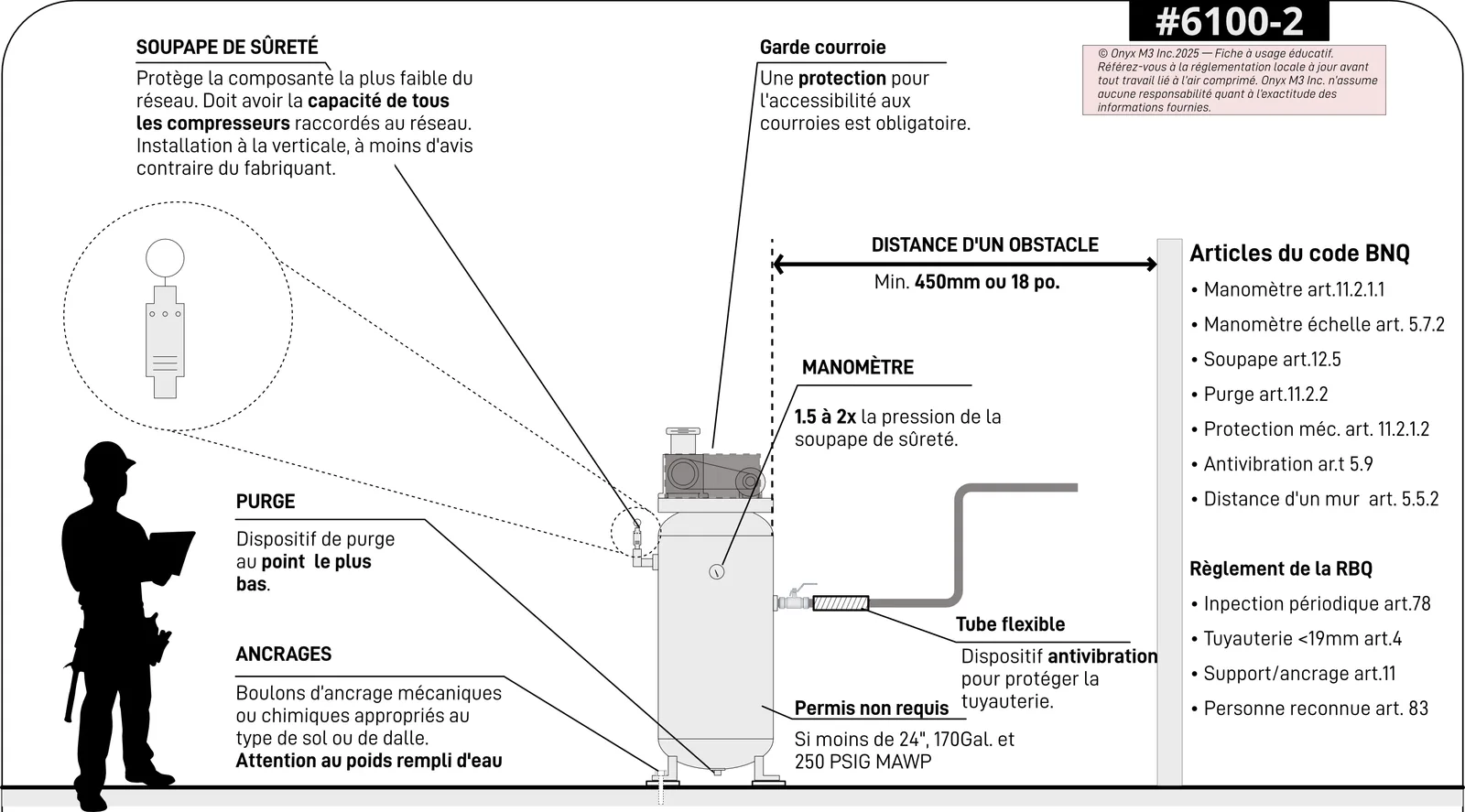
- Read the nameplate: PMMP (or stamped equivalent), volume, diameter.
- Confirm that the work is a non-welded connection (no welding on the connection).
- If all four conditions of s. 16, para. 4 are met, the installation-permit exemption may apply to that work.
- If any condition is missing, return to the usual framework: RBQ permit, declaration, installation code. See the RBQ / CRN guide and the mandatory inspection article.
- Do not confuse this with the mobile receiver (2028), or with a CRN change that paragraph 4 does not state.
To go further, without replacing the official text: the guide to compressed-air receivers in Québec, the RBQ training on pressure receivers (French), RBQ resources or a consultation.
References
- Order in Council 1056-2026, Gazette officielle du Québec, 15 July 2026, 158th year, No. 28, Part 2: PDF.
- Regulation respecting pressure installations (B-1.1, r. 6.1): LégisQuébec (consolidation may still predate the Order).
- RBQ, regulation published, coming into force (15 July 2026).
- RBQ, laws and regulations, pressure installations.
- RBQ, codes and standards, pressure installations.
- Onyx M3: Guide, compressed-air receivers in Québec (RBQ permit and CRN).
Author: Onyx M3 inc., experts in compressed air and RBQ compliance. September 2026.