
Dew point in compressed air
The dew point is the temperature at which the water vapour in the air starts to condense into liquid water. In compressed air it is the key indicator of how dry the air is: the lower it is, the drier the air, and the less water builds up in the network, the tools and the processes.
Under pressure, not at atmosphere
In compressed air we talk about the pressure dew point. It is the value measured at the network’s working pressure, for example 100 psig. It is what tells you whether water will condense in your lines.
There is also the atmospheric dew point, measured at ambient pressure: for the same air, it is always lower. The two are not interchangeable. When comparing two dryers or two specifications, make sure the dew points are given at the same pressure, otherwise the comparison is meaningless.
Why it matters in a plant
When the air cools below its dew point, water condenses. In practical terms, in a plant this means:
- water in the hoses and at the tool stations, damaging cylinders and pneumatic tools;
- rust in steel piping and particles that travel all the way to the points of use;
- product rejects wherever the air touches the material (painting, blowing, food processing);
- freezing when the line runs into the cold, blocking valves, drains and instruments.
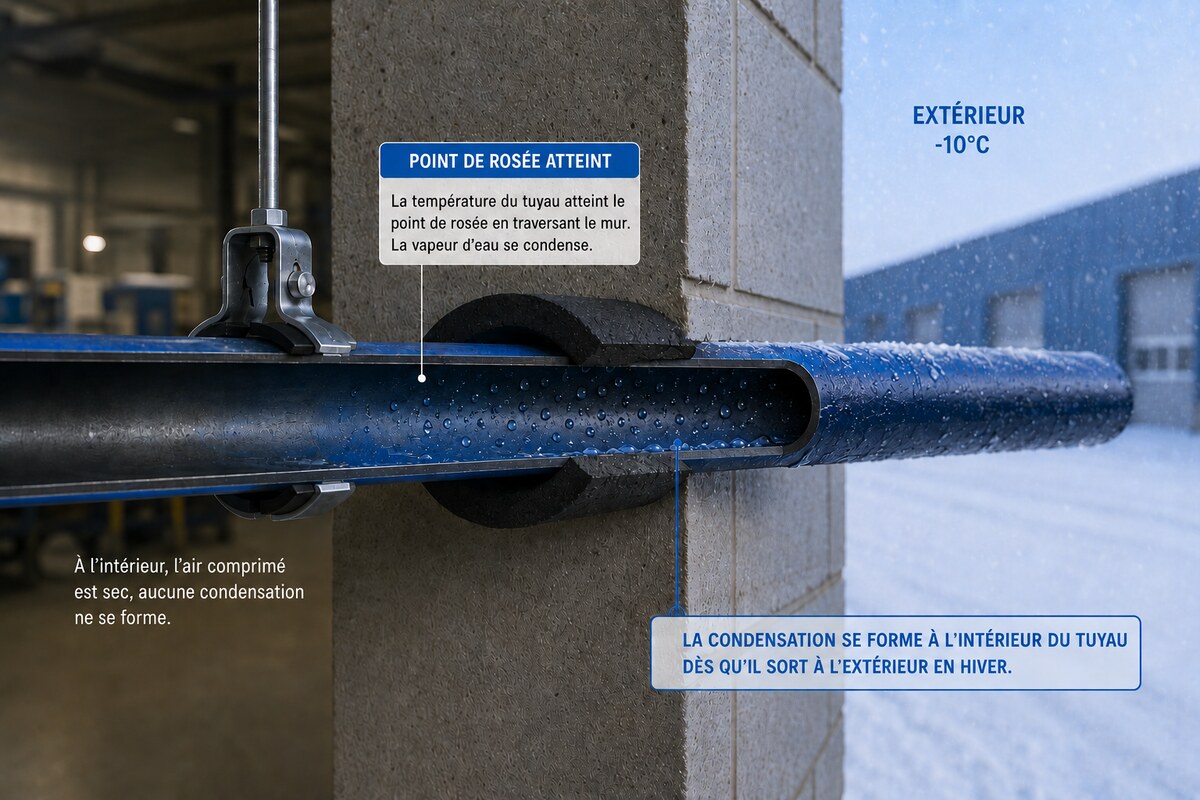
Example. A network dried to +3 °C is fine as long as it stays indoors, in the warm. Run it along an outside wall in January and the condensed water freezes in the line: this is exactly the case where a negative dew point was needed.
Dew point below freezing
This is the dividing line between the two main families of dryers. A refrigerated dryer cannot go below freezing: the water would freeze inside its heat exchanger. Its practical floor is about +3 °C.
As soon as the dew point must drop below 0 °C, you need a desiccant dryer (adsorption), which reaches −40 °C as standard and −70 °C optional. To choose between the two technologies, see Refrigerated or desiccant air dryer: how to choose.
ISO 8573-1 classes
The ISO 8573-1 standard translates the dew point into water classes:
| Class | Pressure dew point |
|---|---|
| Class 1 | ≤ −70 °C |
| Class 2 | ≤ −40 °C |
| Class 3 | ≤ −20 °C |
| Class 4 | ≤ +3 °C |
| Class 5 | ≤ +7 °C |
| Class 6 | ≤ +10 °C |
The refrigerated dryer covers class 4; classes 1 to 3 require a desiccant dryer. The article Air quality ISO 8573-1 details the three contaminants (particles, water, oil) and how to choose the filters.
Not every refrigerated dryer delivers +3 °C
“Refrigerated = class 4” is an approximation. The dew point you actually get depends on the dryer and its operating conditions. An undersized, fouled, poorly maintained dryer, or one installed in a too-hot room, drifts upward: its pressure dew point can climb to +7 °C (class 5), even +10 °C (class 6). You specified class 4, you get class 5 or 6.
The type of control matters too. A non-cycling dryer runs continuously and holds a stable dew point; a cycling dryer shuts its refrigeration compressor at part load to save energy, at the cost of a dew point that swings up a little. The details of these trade-offs (cycling or non-cycling, sizing, correction factors) are in the article Choosing a refrigerated dryer.
Key point. Check the actual pressure dew point, at your plant’s conditions (inlet pressure, air temperature, ambient temperature), not just the class quoted in the catalogue. It is the value actually reached that determines your ISO class.
How to lower it, how to measure it
You lower the dew point with a dryer. A separator and drains remove already-liquid water but do not change the dew point: only the dryer acts on the vapour. For diagnosing water in a network, see Water in the compressed-air network.
In the field, the dew point is often read directly from the dryer’s controller or with a dew-point hygrometer. An upward drift (the air becoming more humid) is a warning sign: an undersized, overloaded dryer, or one starting to fail.
References
- ISO 8573-1:2010, Compressed air, Part 1: contaminants and purity classes.
- CAGI, Compressed Air and Gas Institute.
- Onyx M3 articles: Air quality ISO 8573-1, Choosing a refrigerated dryer, Water in the compressed-air network.