
Compressed-air condensate: production, draining and treatment
Every compressed-air system produces condensate: the ambient air the compressor draws in contains water vapour, and compression concentrates it until it condenses. On a lubricated compressor, that condensate also carries oil. The result is a water + oil effluent that must be drained from the system, separated to recover the oil, then discharged in compliance with municipal standards.
In brief:
- Where it comes from: humid air is compressed then cooled; the water vapour condenses mainly at the aftercooler and the dryer.
- How much: it depends on humidity, intake temperature, pressure and flow. Estimate it with the calculator — Water removal.
- Why treat it: it is oily; discharging it untreated is prohibited (see the discharge standards in Québec).
- How: 1) drain it with zero air loss (electronic BEKOMAT drain); 2) separate the oil from the water (OWAMAT, QWIK-PURE or BEKOSPLIT depending on the condensate); 3) discharge compliant water.
This guide explains the principle, the volume to expect, and above all how to size each stage from the manufacturers’ real data — from the standpoint of an advisor independent of the brands.
Where condensate comes from
Atmospheric air always contains water vapour. When the compressor compresses it, it reduces its volume 7 to 10 times: the same amount of vapour is packed into a much smaller volume, and the air becomes saturated. As soon as it is cooled — at the aftercooler, in the receiver, then in the dryer — the excess vapour condenses into liquid water.
The temperature at which this happens is the pressure dew point. The lower you push it, the more water you remove and the less remains downstream. To grasp this notion, see our articles Dew point in compressed air and Water in the compressed-air system.
Most of the condensate forms at the aftercooler (the air leaves the compressor very hot and moisture-laden), then at the dryer. That is where drains are installed, complemented by drains at the system’s low points and at the separators.
How much condensate to expect
The amount is far from trivial: a plant can produce anywhere from a few litres to several hundred litres of water per day. It depends on four factors:
- the relative humidity and temperature of the intake air (a hot, humid summer produces far more than a dry winter);
- the compressed-air flow (the more air you produce, the more water condenses);
- the operating pressure;
- the dew point targeted by the dryer (the lower it is, the more water is extracted).
Rather than quoting a generic figure, estimate yours with the calculator — Water removal: it computes the water condensed at the aftercooler and the dryer for your inlet and outlet conditions. That volume is the input for sizing the drains and, for emulsions, the BEKOSPLIT separator.
Key point. You size drains and gravity/adsorption separators on the air flow (SCFM), but you size an emulsion separator on the condensate volume (gal/h). Knowing both — your flow and your water production — prevents selection errors.
Why it cannot be discharged untreated
Condensate from a lubricated compressor contains oil at several hundred to several thousand mg/L. Municipal bylaws limit the oil discharged to the sewer: in Québec City, 15 mg/L of C10-C50 hydrocarbons to the domestic sewer and 3.5 mg/L to the storm sewer (bylaw R.A.V.Q. 1124). An oil/water separator is mandatory, and adding emulsifiers is prohibited.
For information only. Discharge limits are set by municipal by-law (the example above applies to the Québec City agglomeration, R.A.V.Q. 1124) and may change. Each operator is responsible for verifying the requirements applicable to their workplace with their municipality.
The detail of the thresholds, obligations and discharge points is in our reference article: Discharging compressed-air condensate: the standards in Québec. This article focuses on the equipment: drain, then separate.
The condensate-management chain
A clean installation follows three steps:
- Drain the condensate out of the system without wasting compressed air → electronic BEKOMAT drain.
- Separate the oil from the water → OWAMAT (gravity), QWIK-PURE (high-efficiency) or BEKOSPLIT (emulsions) separator.
- Discharge sewer-compliant water, and dispose of the recovered oil as waste.
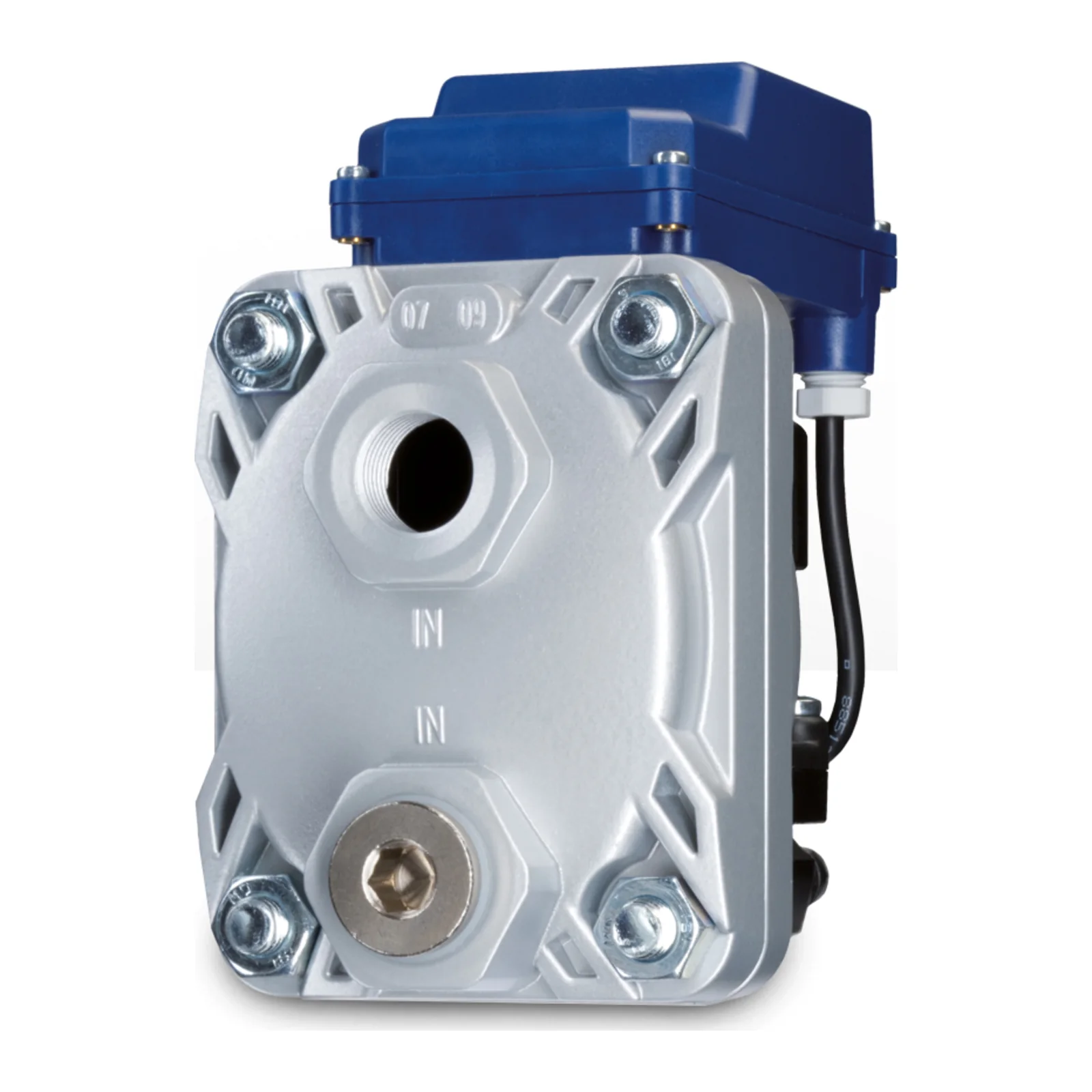
Step 1 — Drain with zero air loss: the BEKOMAT
The most common trap is the timed drain (a solenoid valve that opens at a fixed interval). Every time it opens with no condensate, it vents compressed air — money escaping continuously. The zero-air-loss electronic BEKOMAT drain instead senses the condensate level with a capacitive sensor and only opens when there is water to discharge: zero air loss.
How to size a BEKOMAT
You choose the model based on the compressed-air flow (SCFM) at the drain point and the operating pressure, staying below the drain’s rated capacity. Here is the standard-range ladder (aluminium body, up to 232 psig):
| Model | Capacity (compressor) | Max. pressure |
|---|---|---|
| BEKOMAT 31 | 100 SCFM | 232 psig |
| BEKOMAT 32 | 225 SCFM | 232 psig |
| BEKOMAT 33 | 500 SCFM | 232 psig |
| BEKOMAT 13 | 1,300 SCFM | 232 psig |
| BEKOMAT 14 | 5,400 SCFM | 232 psig |
| BEKOMAT 16 | 50,000 SCFM | 232 psig |
To these are added specialized versions: hard-coated aluminium body (suffix “CO”, for the oily/aggressive condensate of lubricated compressors), CRN-approved models, high-pressure (up to 912 psig), centrifugal (very high flows), stainless and explosion-proof (ATEX).
Method: add up the flow of the compressors connected to that drain point, check your pressure, then pick the model whose capacity covers that flow; choose the “CO” version if the condensate is oil-laden, and the CRN version if your installation requires it. The full matrix (part numbers, prices, versions) is on the Condensate drains page.
Step 2 — Separate oil from water: three technologies
Once drained, the condensate must pass through an oil/water separator before discharge. The right choice hinges on a single question: is your condensate emulsified or not?
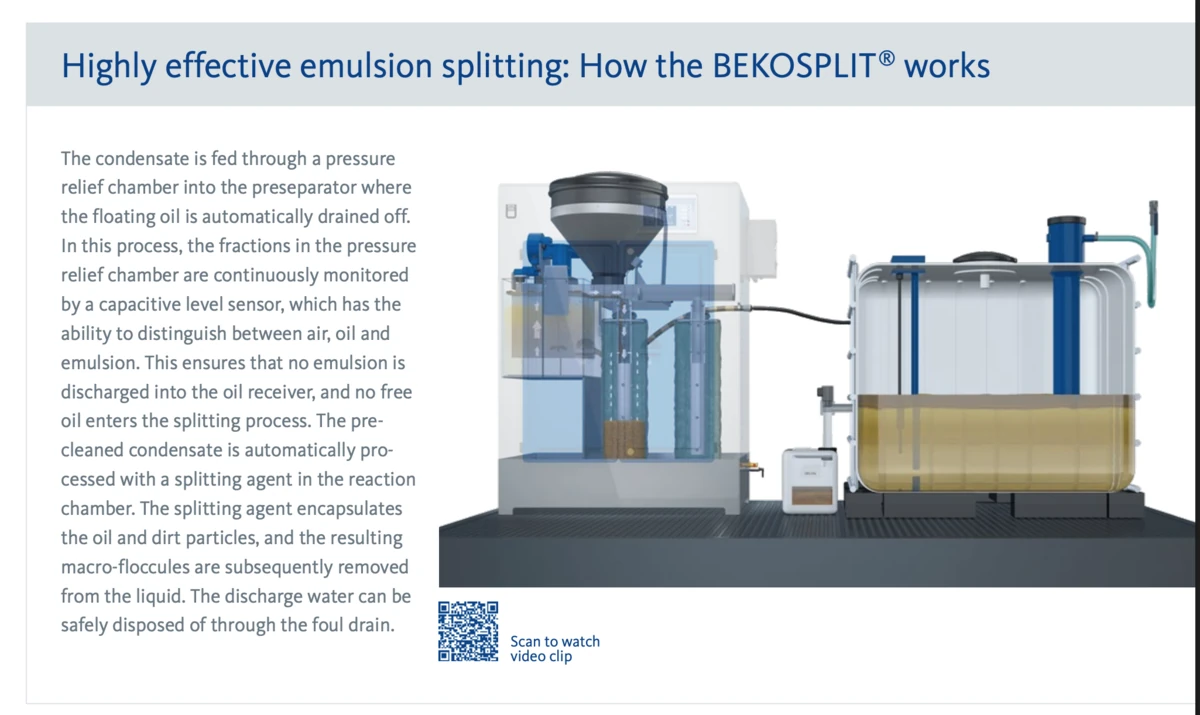
What is an emulsion? At rest, oil and water normally separate: being lighter, the oil rises and forms a distinct layer you can skim off — this is non-emulsified condensate. An emulsion is the opposite: the oil is broken into microscopic droplets dispersed and stabilized in the water, which no longer rise; the mixture stays cloudy and milky, sometimes indefinitely. Synthetic, detergent or “emulsifying” compressor oils, mechanical agitation and heat all promote this stabilization. The practical consequence: non-emulsified condensate is treated by gravity or adsorption (OWAMAT, QWIK-PURE), whereas a stable emulsion must first be “split” — a flocculation agent binds the oil into flocs that are then filtered out — which is what the BEKOSPLIT does.
- Non-emulsified (oil and water separate on their own at rest — the case with mineral oils) → OWAMAT (gravity) or QWIK-PURE (high-efficiency).
- Stable emulsion (oil stays dispersed, the water looks milky — common with synthetic/emulsifying oils) → BEKOSPLIT (splitting).
Simple test. Let a sample of condensate sit in a clear jar for a few hours. If a clear oil layer rises to the surface, the condensate is not emulsified (gravity/adsorption will do). If it stays cloudy and milky, it is a stable emulsion: you need a BEKOSPLIT.
| Criterion | OWAMAT | QWIK-PURE | BEKOSPLIT |
|---|---|---|---|
| Technology | Gravity + adsorption | High-efficiency adsorption | Flocculation + bag filtration |
| Power | None (no electricity) | None (no electricity) | Electric |
| Condensate type | Non-emulsified | Non-emulsified | Stable emulsions |
| Sized on | Compressor capacity | Air flow (SCFM) | Condensate volume (gal/h) |
| Saturation indicator | — | Yes (iCS series, and CS 400) | — |
| All oil types | Depends on oil type | Yes, all lubricants | Yes (designed for emulsions) |
All three discharge sewer-compliant water and recover the oil for disposal. Detail and prices: Condensate treatment.
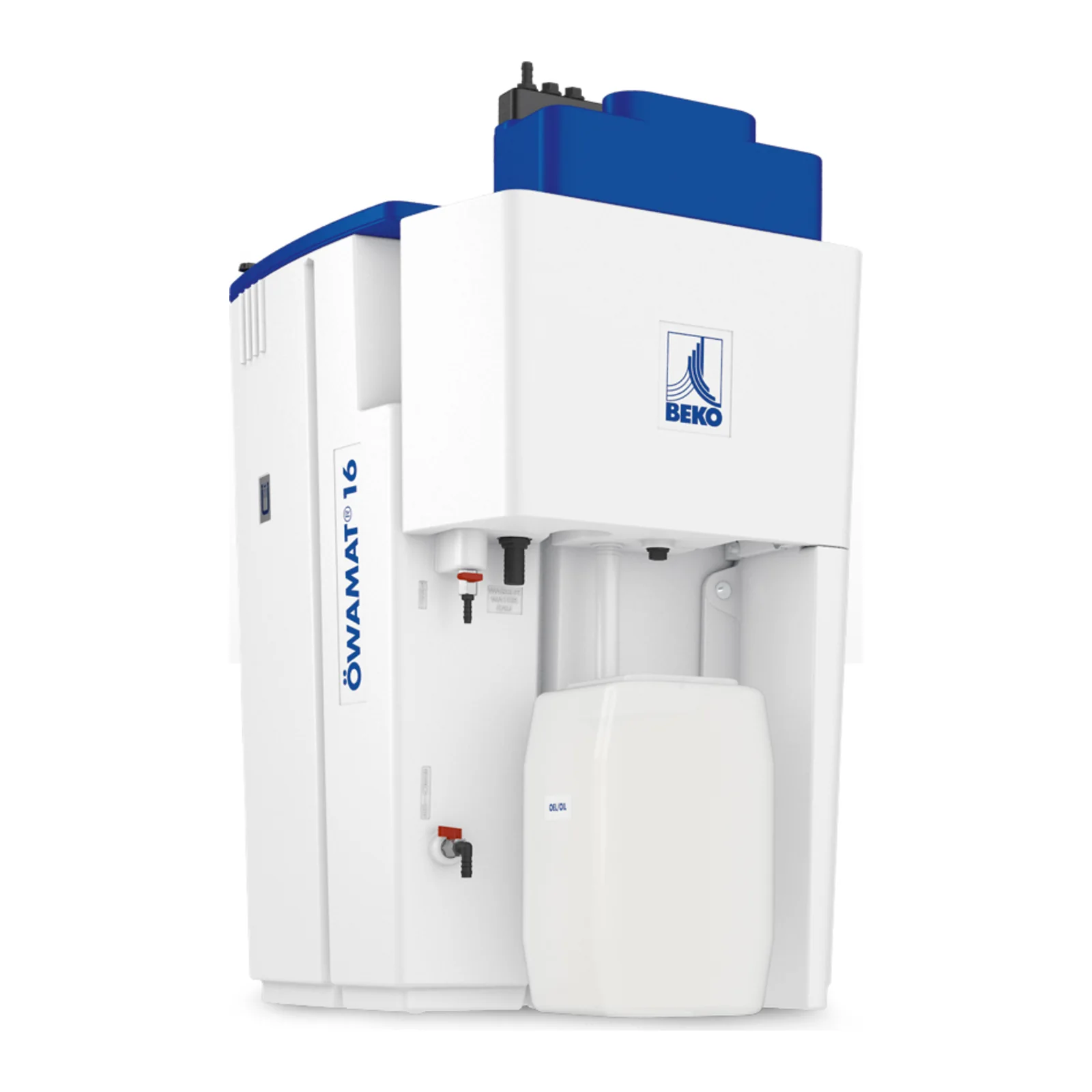
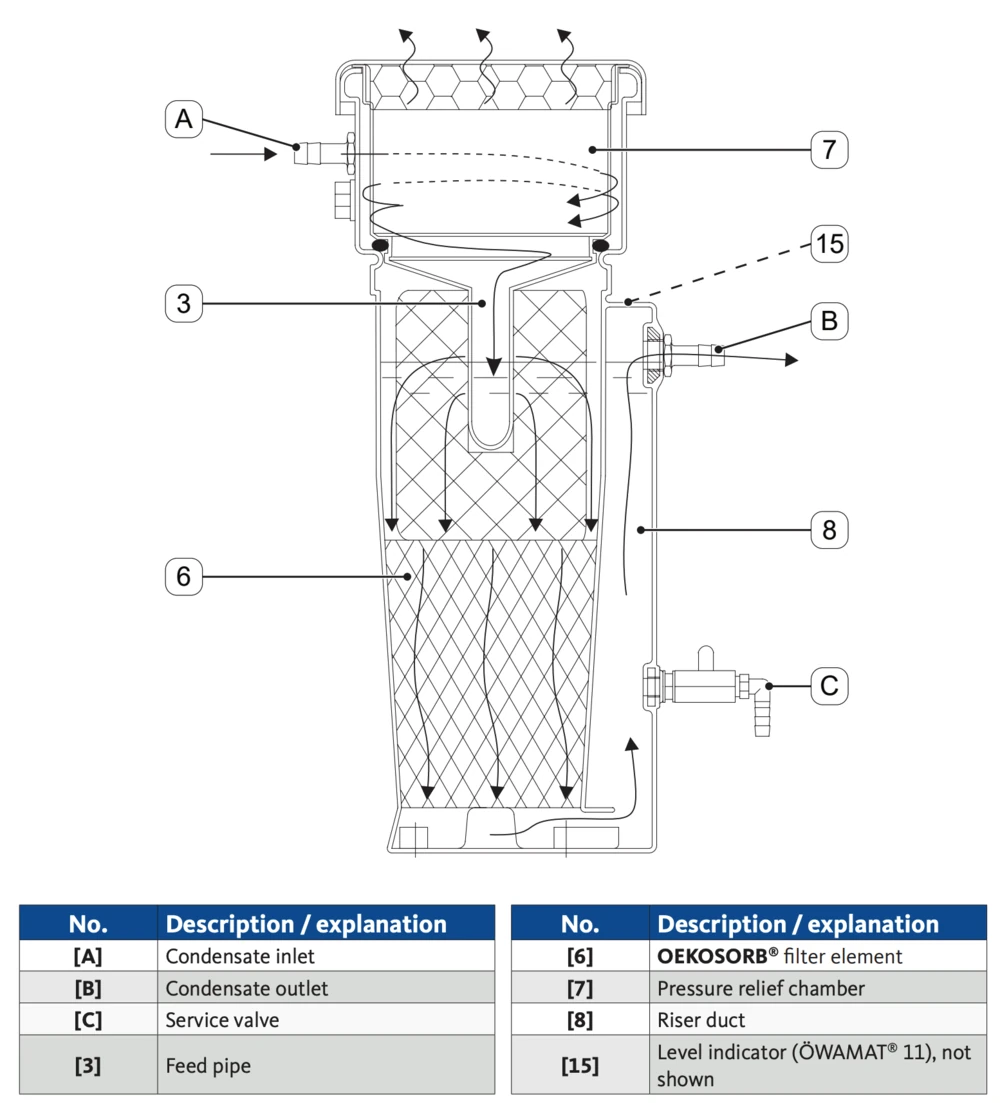
Sizing an OWAMAT (gravity)
The OWAMAT separates oil by gravity and adsorption, without electricity. One important quirk: its capacity depends on the compressor’s oil type and on the climate. Mineral oils (turbine, VDL) separate easily; harder oils (VCL, synthetics) reduce capacity. Québec’s cold climate works in our favour: capacity is highest here (the “Northern” climate zone, which includes Canada).
Capacities for a screw compressor, in a cold climate (installed compressor capacity):
| Model | Mineral oil (turbine / VDL) | Synthetic oil |
|---|---|---|
| OWAMAT 12 | 8.5 m³/min (≈ 300 cfm) | 6.5 m³/min (≈ 230 cfm) |
| OWAMAT 15 | 33.6 m³/min (≈ 1,185 cfm) | 25.9 m³/min (≈ 915 cfm) |
Piston compressors give slightly lower values, and the manufacturer notes a possible deviation of ±20 to 40 % depending on the oil. Onyx M3 stocks the OWAMAT 12 and 15; sizes 10, 14 and 16 are available on quote to cover intermediate and high flows.
Sizing a QWIK-PURE (high-efficiency)
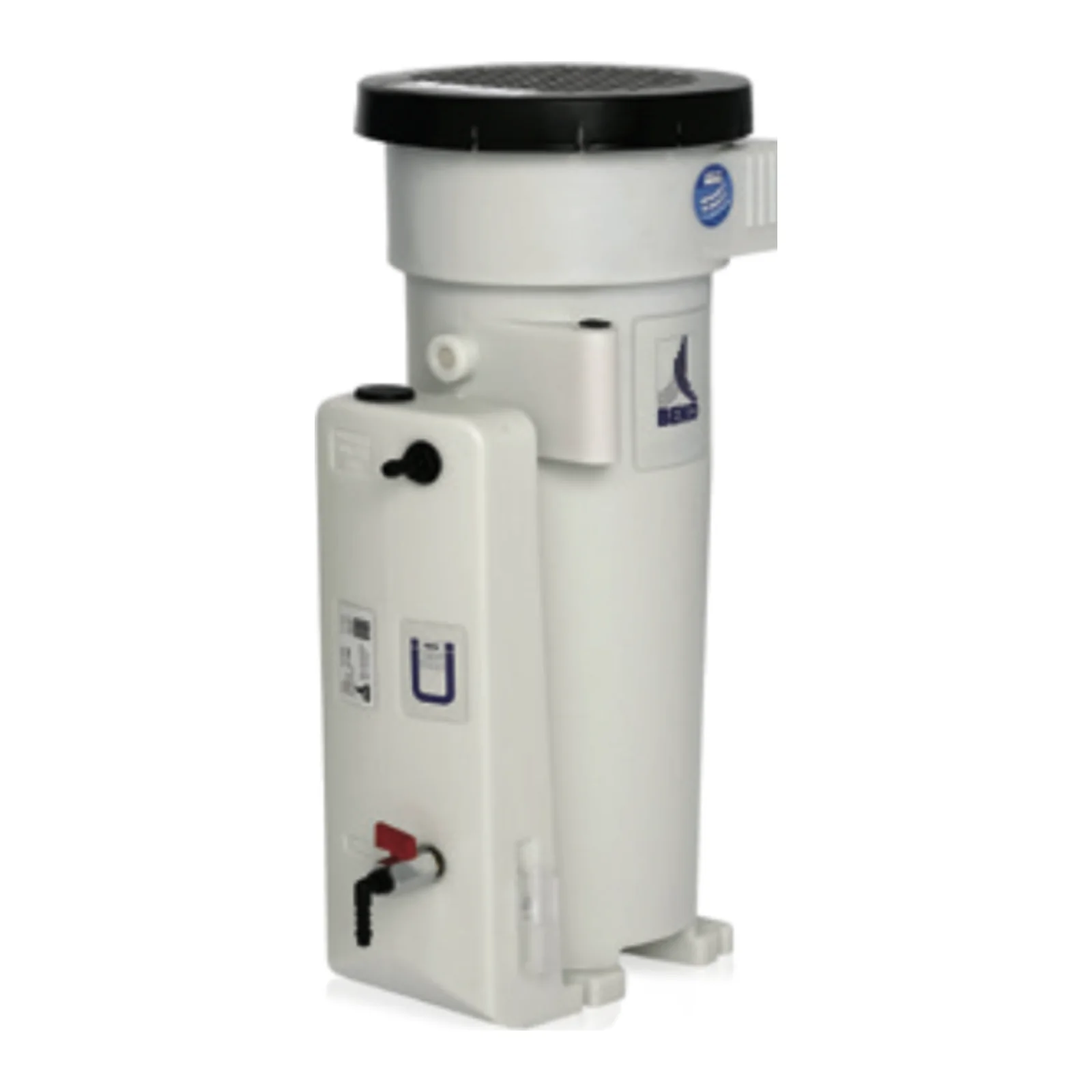
The QWIK-PURE is a high-efficiency adsorption separator, also without electricity, with two advantages over the OWAMAT: it works with all lubricant types (no oil-type penalty), and the iCS series includes a cartridge saturation indicator (the CS 400 too). You size it directly on the air flow (SCFM):
| Model | Flow | Saturation indicator |
|---|---|---|
| QWIK-PURE CS 100 | 100 SCFM | — |
| QWIK-PURE CS 200 | 200 SCFM | — |
| QWIK-PURE CS 400 | 400 SCFM | Yes |
| QWIK-PURE iCS 550 | 550 SCFM | Yes |
| QWIK-PURE iCS 1100 | 1,100 SCFM | Yes |
| QWIK-PURE iCS 2200 | 2,200 SCFM | Yes |
| QWIK-PURE iCS 3300 | 3,300 SCFM | Yes |
The CS (compact) series covers 0 to 400 SCFM; the iCS (intelligent) series runs from 550 to 3,300 SCFM. These flows apply to a cool temperate climate — the case in Québec, where the correction factor is 1.0. In a hot, humid climate you must apply a correction factor (down to about 0.80): multiply the rated flow by that factor before comparing it to the installation’s actual flow.
Sizing a BEKOSPLIT (emulsions)
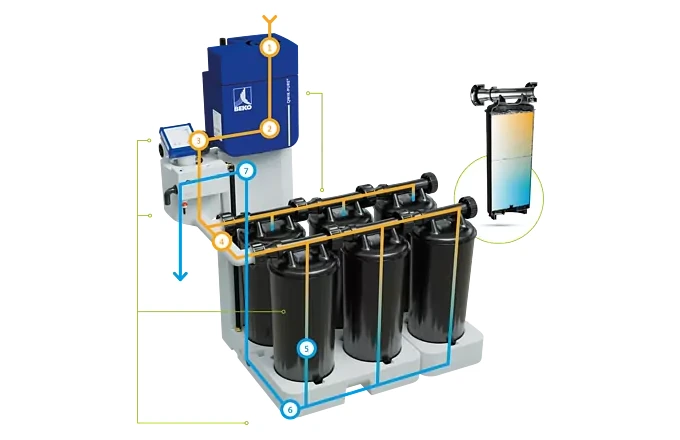
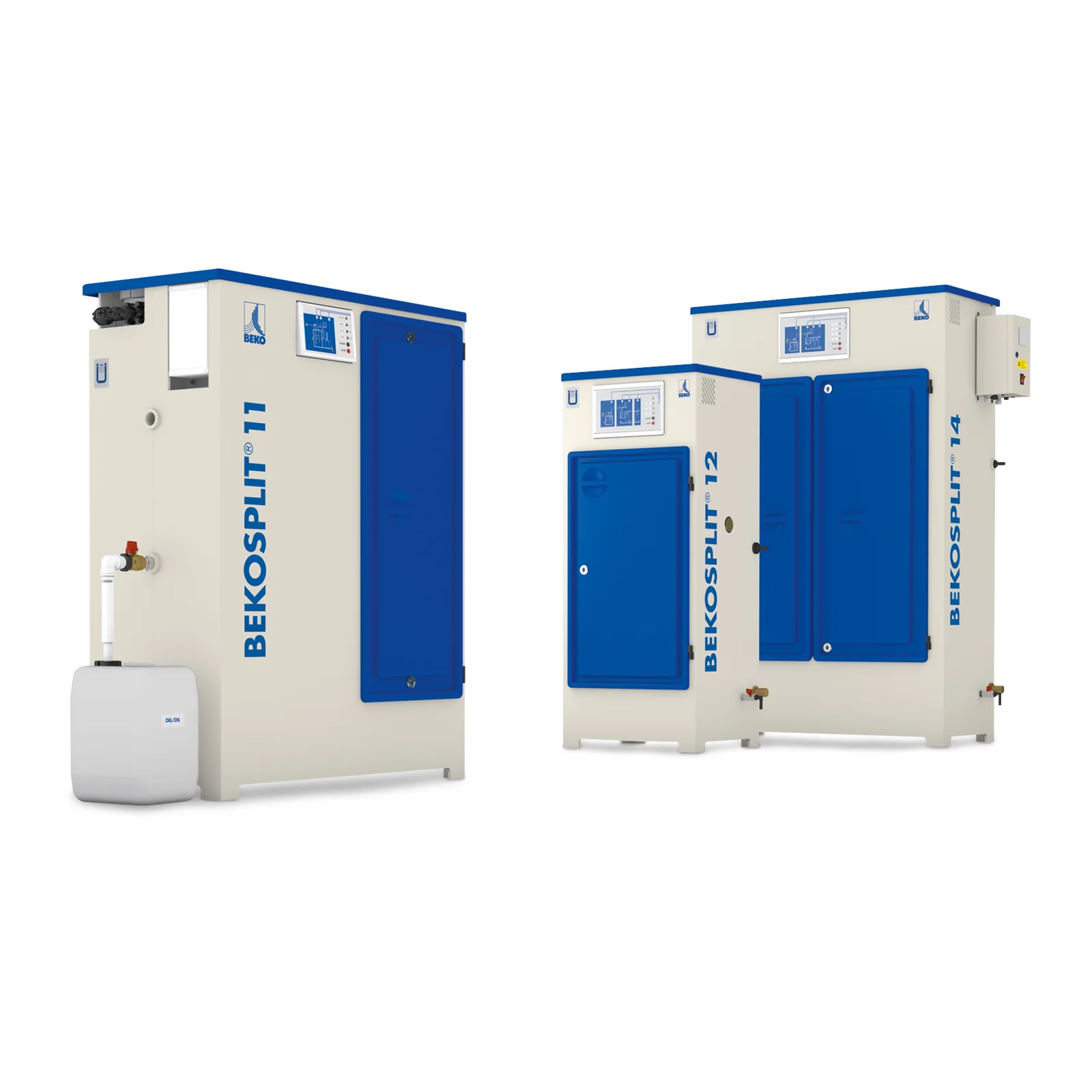
When the condensate is emulsified (the oil does not rise on its own), neither gravity nor adsorption is enough. The BEKOSPLIT injects a flocculating agent that binds the oil, then bag filtration separates the water. It is an electric plant, and most models require a pre-separation tank (ordered separately; the BEKOSPLIT 11 has one built in).
You size it on the condensate volume to treat (gal/h) — hence the importance of having estimated your water production beforehand:
| Model | Treatment capacity | Power |
|---|---|---|
| BEKOSPLIT 11 | 4 gal/h | 100–230 V (integrated tank) |
| BEKOSPLIT 12 | 8 gal/h | 115 V |
| BEKOSPLIT 13 | 16 gal/h | 115 V |
| BEKOSPLIT 14 / 14S | 24 gal/h | 115 V |
| BEKOSPLIT 15 | 32 gal/h | 115 V |
| BEKOSPLIT 16 | 42 gal/h | 115 V |
Video demonstrations
Manufacturer demos (CAG / BEKO YouTube channel). The thumbnail opens the video on YouTube — no player loads before you click.
 Zero-air-loss BEKOMAT drain
 OWAMAT oil-water separator
 QWIK-PURE separator
 BEKOSPLIT emulsion separator
Which one to choose?
The selection logic comes down to a few rules:
- Non-emulsified condensate, no electricity, small to medium flow → OWAMAT (the simplest and most economical), validating the oil type.
- Non-emulsified condensate, all lubricants, saturation monitoring wanted, up to 3,300 SCFM → QWIK-PURE (CS up to 400 SCFM, iCS beyond).
- Stable emulsion (synthetic/emulsifying oils, milky condensate) → BEKOSPLIT, sized on the condensate volume.
If you are unsure whether the condensate is emulsified, do the jar test — or request a characterization of the effluent, which is required in any case above 10,000 m³/year of discharge (see the standards article).
Pitfalls to avoid
- Keeping a timed drain “because it works”: it wastes air continuously. The payback on a zero-air-loss drain is often quick.
- Adding an emulsifier, a solvent or hot water to flush the oil to the sewer: it is prohibited and turns separable condensate into an unmanageable emulsion.
- Undersizing the separator by forgetting the oil type (OWAMAT) or the climate (QWIK-PURE).
- Choosing a gravity separator for an emulsion: the discharged water will stay non-compliant. Do the jar test first.
- Forgetting to replace the cartridges (OEKOSORB): a saturated separator stops separating. The QWIK-PURE iCS series flags it.
- Discharging to the storm sewer without enhanced treatment: the limit is far stricter there (3.5 mg/L in Québec City). Prefer the domestic sewer.
Unsure about your selection? We help, even without a purchase
Sizing condensate equipment correctly depends on your flow, your oil type, your water production and your discharge point. Our role is first to help you choose right — the right drain and the right separator — whether you buy from us, from your usual supplier or elsewhere. We are independent of the brands.
Book a free consultation, estimate your water production with the calculator, or compare the ranges: condensate drains and oil/water separators.
References
- BEKO Technologies — BEKOMAT, ÖWAMAT (capacity table by oil type and climate zone), QWIK-PURE (climate correction factors) and BEKOSPLIT (gal/h capacities) brochures and datasheets, distributed by CAG Purification.
- Onyx M3 — article Discharging compressed-air condensate: the standards in Québec (bylaw R.A.V.Q. 1124: 15 mg/L to the domestic sewer, 3.5 mg/L to the storm sewer).
- Onyx M3 — compressed-air calculator (“Water removal” tool), articles Dew point and Water in the compressed-air system.
Author: Onyx M3 inc., compressed-air experts, independent of the brands. June 2026.